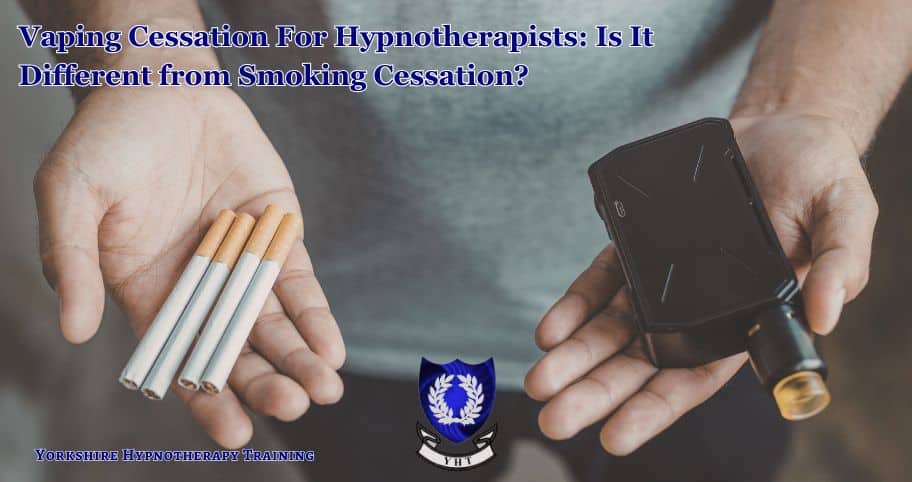
Most hypnotherapists who help clients stop vaping have probably adapted a smoking-cessation programme. That seems sensible: both behaviours involve nicotine, cravings and learned associations. But is vaping cessation for hypnotherapists simply smoking cessation with a different device, or are there important differences in the habit itself?
The more I read about vaping, the more I wonder.
Can Hypnotherapy Help Vapers Quit?
The evidence we have at the moment suggests that vaping is likely to be less harmful than smoking, at least in the short to medium term, and this is the advice given out by the NHS.
However, it’s not completely harmless, and the long-term effects are still being researched. (Lindson et al., 2025) This is at least partly because it’s a new product; there aren’t people around who have vaped for decades. That offers quite a challenge to therapists, although the unknown effects can be one motivator to quit vaping.
Admittedly, research about vaping and how to quit it is in its very early stages, especially when compared with smoking. But from what there is, it’s clear that smoking and vaping have significant differences as well as similarities. Vaping isn’t just smoking with a different device.
What Do Smoking and Vaping Cessation Have in Common?
- Both smokers and vapers may continue their habit because of nicotine dependence.
- Smoking and vaping can both be strongly associated with specific triggers, such as boredom, stress, or tiredness. Or clients might use them when socialising, concentrating, or relaxing.
- Quitting might involve cravings and withdrawal.
- Both vapers and smokers can be definite they want to quit, without having a clear idea of how to go about it.
Given this, many hypnotherapists offer quit vaping support by adapting an existing smoking programme. I’ve done it myself, and it’s worked, so I’m not suggesting that vaping cessation needs a completely new approach. With both sets of clients, you need to find out:
- Why the client wants to quit.
- Their motivations and concerns around quitting.
- Triggers and what keeps them smoking or vaping.
- Have they planned coping strategies to help them through difficult moments or cravings? (And provide them if not.)
- What will they do instead of smoking or vaping, for example to cope with stress or boredom?
- What will life be like without their habit?
Differences Between Smoking and Vaping
The cigarette has an ending
One difference that interested me is how easily vaping fits into everyday life and how continuous it can become. Smoking has specific stops and starts.
- Trigger.
- Get the cigarette out of the pack.
- Light it.
- Smoke it.
- Finish it.
There’s a clear behavioural episode with an obvious start and finish. That doesn’t mean every cigarette is smoked that way, of course. Some are abandoned partway through, and the speed at which people smoke varies. Even so, there is a natural ending when you stub out the cigarette.
Vaping doesn’t always work like this. Vapers can take a few puffs at odd times throughout the day. They may pick up a vape and put it down again in a way they can’t with cigarettes, rather than having a start-to-finish routine. E-cigarette smokers often have longer and more variable times of use than traditional smokers, and there’s no obvious ending. (St Helen et al., 2016; Lee et al., 2018).
A smoker might say, “I smoke after meals.” A vaper might say, “I vape all the time,” or “I don’t really know when I do it.” The first statement gives us a recognisable trigger to explore, and a context for replacement behaviours. The second is somewhat trickier.
That can be important for therapists. You might have to put more emphasis on letting go of automatic, habitual behaviours with a vaper than you do with a smoker.
Sign up for YHT's Newsletter: tips, research, articles and training discounts
Vaping can be harder to notice
We’ve probably all come across people who smoke and aren’t fully aware of their habit. But for most people, smoking is more obvious than vaping. They have to go outside, or delay smoking until they can. Smokers may worry about the smell or other people’s opinions. They know how many cigarettes they smoke a day.
Vaping can be easier to fit around everyday activities and to conceal. Vapers can carry the device in their pocket and take an occasional puff without interrupting other activities. In fact, the behaviour can become so automatic it is barely noticed. Research suggests that this “automaticity” can be an important factor in maintaining the habit. (Martin et al., 2024).
A client who vapes may genuinely not know how often they do it. They can measure use to some extent by how much liquid they buy, or how long a disposable lasts, but the individual number of puffs or times of use might not be so obvious. So, asking “How many times a day do you vape?” might not help us to provide meaningful therapy.
More useful questions might therefore include:
- Where is the vape kept during the day?
- How soon after waking is it used? (Less than 30 minutes is assumed by many researchers to indicate nicotine addiction.)
- Is it used in short bursts or longer sessions?
- Is it usually in the client’s hand, pocket or within reach?
- What happens when the battery is charging?
- How does the client feel when the device is empty or unavailable?
- Are there occasions when the client vapes without noticing that they have picked it up?
- Does the client also smoke cigarettes? If so, do they want to quit both habits?
Vapers’ and smokers’ motivations to quit
Smokers and Vapers might both want to beat addiction or save money when they quit their habit. But many smokers are focused on the negative effects of smoking itself. For example, the smell, taste, inconvenience, disapproval from family and friends (or doctors), coughing, expense, or known health risks.
Those who started vaping as a way to quit cigarettes may have concerns not shared by those who have never smoked. For example, they might worry that quitting vaping will take them back to smoking.
Vapers’ health worries may be vaguer, because the effects of long-term vaping are not yet known. Some get anxious if the device isn’t charged. But there is often less inconvenience in vaping, and they may actively enjoy the different flavours available.
In fact, one study with young people found that participants described some barriers to quitting that were stronger in vaping than in smoking. These confirmed what we’ve discussed here: enjoyment of flavours, the ease and discreetness of vaping, and a lack of awareness of how much they were using (Keating et al., 2021). Overall, vapers tend to identify fewer unpleasant elements of vaping and be motivated more by the idea of being free of a dependency.
So, listen carefully to your client and consider whether you’re working primarily with “towards” or “away from” motivation, adapting your session appropriately.
Comparison of Smokers and Vapers
Smoking
Often involves discrete periods of smoking individual cigarettes.
Usually has a recognisable beginning and end.
Cigarettes per day provides at least a rough measure.
Cues may involve other smokers, lighters, packets, smoking breaks, or environmental triggers like after a meal or driving.
May dislike the habit or some elements of it.
Health fears may be very specific.
Former smokers may fear relapse.
Vaping
May involve repeated puffs or longer periods of use.
May have less obvious stopping and starting points.
May be hard to quantify.
Cues may be the device, flavours, charging or holding the device.
Vapers often enjoy different flavours and find it harder to describe what they don’t like about vaping.
Health fears may exist but tend to be harder to pin down.
May fear going back to smoking if they used the vapes to quit.
Research on Vaping Cessation
Recent research does support the idea that some existing smoking cessation methods help vapers who want to quit. I couldn’t find any research on hypnotherapy itself, but there is evidence that counselling-based approaches can be useful.
For example, one large-scale study worked with teens who wanted to quit vaping. Both the control and experimental groups received regular text-based assessments to complete. The experimental group also received regular interactive text-message counselling.
These messages aimed to build confidence and skills for quitting, along with cognitive and behavioural coping strategies, such as mindfulness, breathing exercises, self-care advice, and social support. After seven months, 24.1% of the text group had quit vaping, compared with 18.6% in the no-text control group. (Graham et al., 2021).
A later similar study showed 38% in the text group who quit, compared to 28% in the no-text group. (Graham et al., 2024).

How Can Hypnotherapists Help Vapers Quit?
We started by asking if smoking cessation and vaping cessation were the same, and whether the same methods could be applied to help clients.
And my answer is that an adapted smoking-cessation programme is a useful structural starting point, but it shouldn’t be the end of our thinking.
As yet, there is very little research about vaping cessation, so we need to be careful not to make unsubstantiated claims about what we can achieve. And I couldn’t find any research at all in this area that included hypnotherapy.
However, the research we do have suggests that cognitive-behavioural-based interventions have been useful. It seems like a reasonable assumption that this type of support would be just as helpful in hypnotherapy as in counselling to help clients quit vaping.
Smoking and vaping have enough in common for many smoking-cessation principles to remain relevant. We can use hypnosis to help clients examine their motivations, imagine a future without vaping, and develop alternative responses. But it also needs adapting to allow for the differences in smoking and vaping discussed above.
Adapting Hypnotherapy Sessions to Help Clients Quit Vaping
Reasonable adaptations to your usual quit smoking session might include:
- Identifying whether the client is an exclusive vaper, former smoker, or dual user.
- Using the questions above to assess vape use, rather than relying only on “vapes per day”.
- Asking about device, flavour, location, emotional and social cues.
- Exploring what the vape does for the client: nicotine relief, stimulation, stress regulation, occupation, identity, social connection, or a substitute for smoking.
- Discussing coping strategies and replacement behaviours to help the behavioural change.
- Making sure the client has strategies to deal with cravings.
- Addressing the lack of a natural ending to vaping by creating deliberate stopping points, if the client wants to stop gradually. Or limit the times the vape can be used. (If the client is stopping completely, this makes a good preparation task in the run-up to the appointment.)
- Exploring the client’s fears of losing vaping, for example, returning to cigarettes.
- Using motivational interviewing, CBT-informed strategies, and other familiar approaches to provide motivation and confidence.
- Monitoring withdrawal and relapse separately for vaping and smoking, where the client is quitting both.
References
Barnes, J., McRobbie, H., Dong, C.Y., Walker, N. and Hartmann-Boyce, J. (2019) ‘Hypnotherapy for smoking cessation’, Cochrane Database of Systematic Reviews, 2019(6), CD001008.
Graham AL, Amato MS, Cha S, et al. Effectiveness of a vaping cessation text message program among young adult e-cigarette users: A randomized clinical trial. JAMA Intern Med. 2021;181(7):923–930. doi:10.1001/ jamainternmed.2021.1793
Graham, A.L., Cha, S., Jacobs, M.A., Amato, M.S., Funsten, A.L., Edwards, G. and Papandonatos, G. D (2024). A vaping cessation text message program for adolescent e-cigarette users. JAMA, 332(9). doi:10.1001/jama.2024.11057.
Keating, P., et al. (2021) ‘Is vaping cessation like smoking cessation? A qualitative study exploring the responses of youth and young adults who vape e-cigarettes’, Addictive Behaviors, 113.
Keijsers, M., Vega-Corredor, M.C. and Hoermann, S. (2022) ‘Cue reactivity to electronic cigarettes: a systematic review’, Tobacco Use Insights, 15.
Lee, Y.O., et al. (2018) ‘Examining daily electronic cigarette puff topography among established users’, Nicotine & Tobacco Research, 20(10), pp. 1283–1289.
Lindson, N., Fanshawe, T.R., et al. (2025) ‘Interventions for quitting vaping: systematic review and meta-analysis’, Tobacco Control, 35(3), pp. 382–390.
Martin, M., et al. (2024) ‘Development and validation of the Self-Report Habit Index for vaping’, Addictive Behaviors Reports, 20.
Stallaard, S-L. (2016) ‘Behavioural psychology and vaping’, Vapour Magazine, Spring, pp. 36–37. Available at: https://www.calameo.com/read/0034202969ec4e96d78d9 (Accessed: 6 August 2026).
St Helen, G., Havel, C., Dempsey, D.A., Jacob, P. and Benowitz, N.L. (2016) ‘Nicotine delivery, retention and pharmacokinetics from various electronic cigarettes’, Addiction, 111(3), pp. 535–544.

About Debbie Waller
Blog Author Debbie Waller is a hypnotherapist, supervisor, and trainer with more than twenty years of experience. As well as having a busy client practice, she runs Yorkshire Hypnotherapy Training and writes books and articles for therapists who want to deepen their knowledge and develop effective practice.
Disclaimer
The information and ideas shared on this blog are based on the author’s professional experience, research, and training. They are intended for educational purposes and to support reflection and professional development. Therapists should always apply their own professional judgment and consider the needs of individual clients when using any techniques or suggestions discussed here.
While every effort is made to ensure the information is accurate and helpful, no responsibility can be accepted for any loss, damage, or difficulties arising from the use or misuse of material contained in these articles.