Have you ever told a client that hypnotherapy is not a magic wand? We’re going to challenge that idea today by showing that sometimes it can be. In this article, we’ll use examples from Harry Potter to demonstrate how fictional ideas can be used to create magical therapeutic metaphors for children.
Popular books and films can provide useful therapeutic metaphors for children, particularly when working with anxiety, confidence or emotional resilience. And although ‘Potter-mania’ may have reduced a bit, many children are familiar with the stories and films.
Some of the spells adapt very well to being used as metaphors in therapy. Plus, of course, some adults are big fans. There’s nothing to stop you using these techniques with them as well.
Therapeutic Metaphors Inspired by Harry Potter
‘Expecto Patronum’
Dementors are the guards at the wizard prison Azkaban. They look a lot like the ‘Ghost of Christmas Future’ from Dicken’s Christmas Carol: tall, with long black robes and hidden faces. They feed on your fears and suck all the good thoughts and joy out of you. J K Rowling drew on her experience of depression to create them (Papisova, 2016), but they can also be used to represent other unhelpful feelings like anxiety.
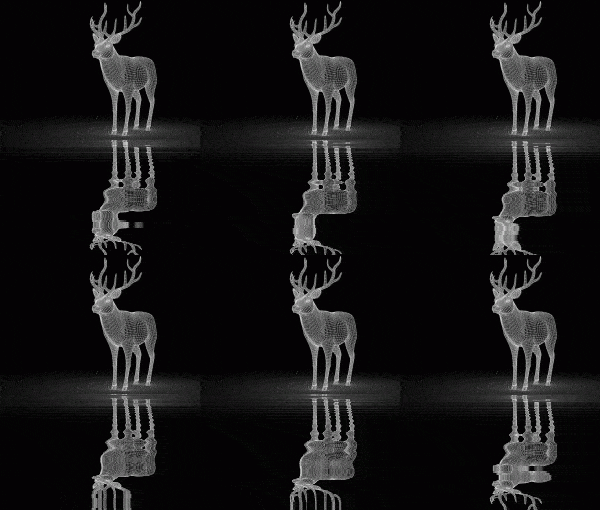
The only way to protect yourself from a dementor is to create a Patronus, which is a kind of guardian. It looks silvery and slightly transparent and is usually in the form of an animal. Harry’s is a stag, Hermione’s is an otter, and Ron’s is a Jack Russell terrier. The type of animal doesn’t affect the Patronus’ power or abilities. A mouse is just as powerful as a lion.
A Patronus is created from a combination of focussing on a happy memory and the incantation expecto patronus. It’s an advanced spell which Harry takes a long time to learn: the first few memories he chooses aren’t powerful enough to overcome his fear. He refuses to give up, and keeps looking for more powerful positive memories until he gets it to work. This is useful if your client finds it challenging to identify a good enough thought to dispel their unwanted feeling.
Questions to ask:
- What’s your happiest memory or experience?
- How does that make you feel?
- What animal would your Patronus be?
Ask them to imagine a dementor is causing their unhelpful feeling and cast the spell, in trance or in role-play. When you have a memory happy enough to work, anchor the feeling of defeating the problem.
Sign up for YHT's Newsletter: tips, research, articles and training discounts
‘Riddikulus’
Boggarts (in HP world, at least) are shape-shifting creatures which lurk under beds and in dark corners. When seen, they look like your worst fear. No-one knows what a boggart looks like when he is on his own. He’s best dealt with by groups so he doesn’t know what shape to take and moving from one shape to another weakens him. You can always enlist the client’s friends or family to help, in their imagination.
The spell to get rid of a boggart is ‘Riddikulus’. This forces him into a new shape that the spell caster finds funny. If you are laughing at him, of course, you can’t be scared. This change of shape is usually accompanied by a loud cracking sound. This spell is especially effective for fears and phobias.
Questions to ask:
- What would a boggart look like to you?
- How could you make that funny?
- Could any of your friends help you?
- What would the boggart look like to them?
- How could they make that funny?
- Then perform the spell, in trance or via role play.
General-purpose therapeutic “spells”
‘Alohomora’
This one opens locked doors. It could be used as part of a wider metaphor, to open the control room, or a door into a magical, happy place etc.
‘Arania Exumai’
This one drives away spiders so it could be good for arachnophobes. If your client’s phobia is about something else, invent something. Most of the spells are based on Latin or Latin-sounding words, so you can use this to make new spells. For example, Felis Exumai for a fear of cats, or Canis Exumai for dogs.
‘Colloportus’
This locks doors, so could be used alongside Alohomora to exit and enter a control room, peaceful place etc.

Mirror of Erised
Not a spell exactly, more a magical gadget. Reading the mirror’s name backwards, you can see this is the Mirror of Desire. When you look into it, it reflects the you that you would like to be. That makes it a great tool for future pacing or getting in touch with self-esteem and good feelings. Have kids see themselves in the mirror without their issue, notice how it feels, looks, sounds, etc. and anchor that. It can be adapted as a version of the Circle of Excellence as well. Just ask the client to step through the mirror into the reflection.
‘Obliviate’
This spell removes memories. To be used with care since playing around with memory in trance can be tricky. But you can perhaps suggest that they forget to carry out an unhealthy habit or thought. For more on hypnosis and memory, see my blog on Can Hypnosis Make Me Forget?
Room of Requirement
Like the mirror, this one isn’t exactly a spell. It’s a magical room which appears when and where you need it. It always contains exactly what you need to solve whatever problem you’re facing. It makes a good alternative to a peaceful place or control room metaphor. Or you could imagine it contains whatever resources your client needs.
‘Wingardium Leviosa’
This one makes things float into the air. It could be combined with the blow-away technique to lift the balloon full of bad thoughts or feelings. Or generally to make unwanted feelings light enough to be released.
Adapting Therapeutic Metaphors for Individual Children
There are other spells listed online (whole websites devoted to them, in fact). And you could always invent your own, or ask your client to do so. Or use other books, TV programmes, films, and video games in a similar way depending on your client’s interests.
I hope you’ve found some ideas to use with your clients here, and that it will inspire you to discover new and inventive ways to help them.
References:
Papisova, V. (2016). How J.K Rowling Helped a Fan Deal With Real-Life Dementors. [online] Teen Vogue. Available at: https://www.teenvogue.com/story/jk-rowling-helps-fan-depression.
Rowling, J. K. (1997) Harry Potter and the philosopher’s stone. London: Bloomsbury.
Rowling, J. K. (1998) Harry Potter and the chamber of secrets. London: Bloomsbury.
Rowling, J. K., (1999) Harry Potter and the prisoner of Azkaban. London: Bloomsbury.
Rowling, J.K. (2000) Harry Potter and the goblet of fire. London: Bloomsbury.
Rowling, J.K. (2003) Harry Potter and the Order of the Phoenix. London: Bloomsbury.
Rowling, J.K. (2005) Harry Potter and the Half-Blood Prince. London: Bloomsbury.
Rowling, J.K. (2007) Harry Potter and the Deathly Hallows. London: Bloomsbury.
A Note on Copyright and Trademarks
Harry Potter and related names, characters and terminology such as spell names are the intellectual property of J. K. Rowling and Warner Brothers.
This article is intended as educational commentary and analysis, looking at how familiar stories and themes can be adapted into therapeutic metaphors and used within one-to-one sessions. No substantial text, images or creative content from the original books or films has been reproduced.
From the guidance I received, using these kinds of ideas verbally with an individual client in a private therapy session is very different from creating commercial products based on them. Turning Harry Potter-inspired material into published scripts, worksheets, recordings, or downloadable resources is likely to be serious misuse of copyrighted and trademarked materials.
I am not a legal expert. As always, if you are unsure how copyright or trademark law applies to your work, it’s best to check with someone who is.

About Debbie Waller
Blog Author Debbie Waller is a hypnotherapist, supervisor, and trainer with more than twenty years of experience. As well as having a busy client practice, she runs Yorkshire Hypnotherapy Training and writes books and articles for therapists who want to deepen their knowledge and develop effective practice.
Disclaimer
The information and ideas shared on this blog are based on the author’s professional experience, research, and training. They are intended for educational purposes and to support reflection and professional development. Therapists should always apply their own professional judgment and consider the needs of individual clients when using any techniques or suggestions discussed here.
While every effort is made to ensure the information is accurate and helpful, no responsibility can be accepted for any loss, damage, or difficulties arising from the use or misuse of material contained in these articles.