
I’m sure many of us have had clients who seem stuck in repeating emotional patterns, especially in their relationships with others. They may always feel responsible for others’ happiness at the expense of their own. Or constantly blame others for their failings, feeling completely helpless and unable to move forward. The Drama Triangle helps to explain why this can happen. And it suggests strategies to help clients move to a healthier place.
In this article:
- What is Kaplan’s Drama Triangle?
- How clients get stuck in the Drama Triangle
- Choy’s Winner’s Triangle
- Practical Tips for using the Triangles in Hypnotherapy
What is the Drama Triangle?
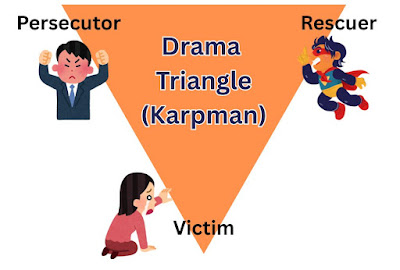
Stephen Karpman introduced the Drama Triangle in 1968. He worked within the framework of Transactional Analysis. The triangle shows the main dysfunctional roles that people can adopt within relationships: these are:
- Victim: associated with feeling powerless, overwhelmed and dependent on others. Victims feel unable to take responsibility for change and don’t value themselves. They can come across as helpless, downtrodden, needy, and somewhat manipulative.
- Rescuer: rushes to help, even at the expense of their own well-being, and takes too much responsibility for others. Rescuers may have a strong desire to be needed, or to appear self-sacrificing, but they don’t value other people’s capacity to help themselves. They can come across as well-intentioned but interfering and overwhelming.
- Persecutor: someone who blames and criticises others and/or uses authority destructively. Persecutors refuse to take any responsibility for their own actions, and don’t value other people’s points of view. They may come across as angry (openly or passively), judgmental, bullying, and spiteful.
The roles are not fixed. People may move between them, depending on context and their relationship with the other person. For example, if a rescuer tries to help someone who doesn’t fall into the expected victim pattern, they may become a persecutor. ‘I tried to help, but she didn’t let me and she has only herself to blame now’. Unfortunately, ‘The triangle is a game in which no one wins, and all roles keep the dysfunction alive.’ (Karpman, 1968)
It’s important to note that this is an unconscious form of role-playing, not deliberately or consciously manipulative. The client may not be consciously aware of how they’re behaving or the impact they have on others.
Sign up for YHT's Newsletter: tips, research, articles and training discounts
How Clients Get Stuck in the Drama Triangle
- Unmet psychological needs: if someone has never felt valued or needed, they may adopt the role of rescuer to experience those feelings. Likewise, a persecutor may need power to make them feel important. Or a victim may hope to attract someone who will take care of them.
- Lack of self-awareness: as said, this is often an unconscious process. The person may be unaware of how their actions appear, or that their current behaviours are keeping them in that role.
- Lack of healthier alternatives: if the person’s role models were dysfunctional, they tend to repeat what they know. Therapy is needed to break the cycle.
- Self-reinforcement: the whole triangle is connected with a lack of personal responsibility, criticism and blaming. As the behaviours reinforce the roles, they can become self-fulfilling prophecies. For example, if a victim meets a persecutor, they may feel more than ever in need of a rescuer.
- Secondary gain: as with any unhealthy coping strategy, there may be benefits to maintaining the roles. A victim can hand over responsibility to their rescuer. A rescuer feels a sense of purpose, and a persecutor feels powerful.
One option is to bring the roles into the client’s conscious awareness. Then they can begin to understand, recognise and change their behaviour. There’s a downloadable handout for clients that will help you do this at the bottom of the article.
Drama to Empowerment: the Winner’s Triangle
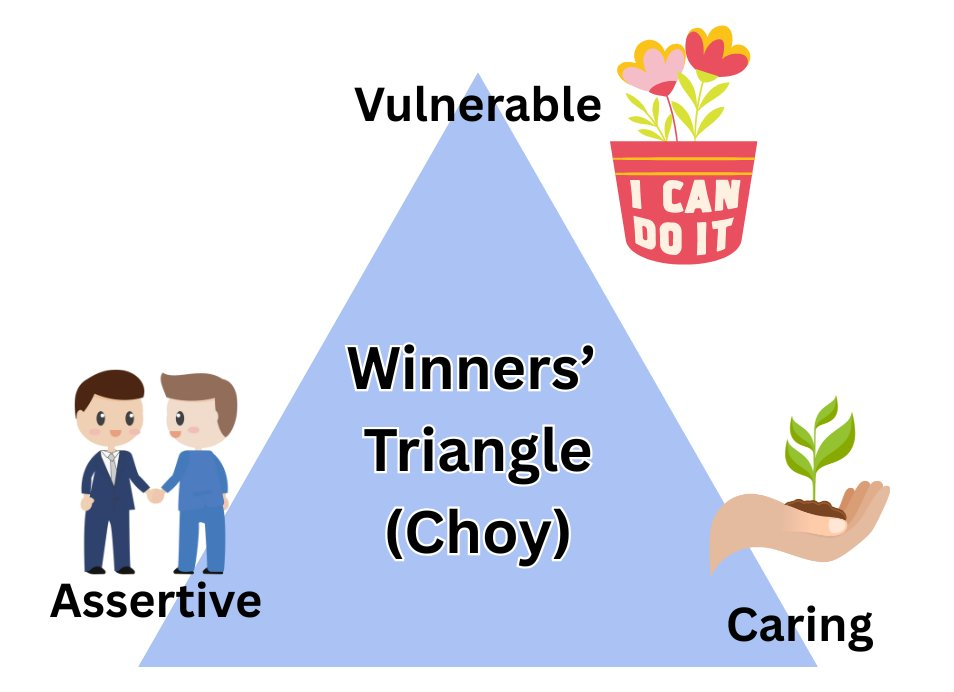
The Winner’s Triangle (Acey Choy, 1990) reflects healthier options. It replaces the three roles on the Drama Triangle with more empowering ones.
These are:
- Vulnerable instead of Victim: allowing people to acknowledge their difficulties whilst accepting their abilities and needs. They can ask for help when it’s needed, but don’t need a rescuer to take over at every setback.
- Caring instead of Rescuer: offering support and empathy to others without taking over. Caring people respect boundaries (their own and other people’s) and offer support and encouragement that doesn’t disempower the other person.
- Assertive instead of Persecutor: having the ability to pursue and communicate your needs without blaming others or becoming aggressive. Assertive people recognise that other people’s needs are as important as their own. They look for cooperation and compromise instead of dominance.
The goal of therapy with individuals stuck in the Drama Triangle is to move them into these healthier options. Therapy can encourage self-awareness, healthy boundaries, and respect for others.

Using the Drama Triangle in Hypnotherapy
In discussions
Start by talking to the client about their situation, perhaps using the free download at the bottom of this article. Remember that the client may be consciously unaware of the role they are playing or why. Neutral language with no hint of blame is essential. Tactfully, ask if it reminds them of anything in their experiences.
Inviting clients to talk about times and places they feel ‘stuck’ is also useful. It can help suggest reframes to help them release that feeling.
In metaphors:
- Metaphors such as dissolving glue or bursting through barriers can represent becoming unstuck.
- Imagine a piece of clothing or object that symbolises the role they’ve been adopting, such as a superhero cape for rescuers. Symbolically remove it from their lives.
- Imagine being lost in a triangular maze, before finding a map that leads you to the exit.
Via suggestions:
- You find new, balanced ways to support others
- You no longer need to prove your worth by fixing other people’s problems
- You no longer need to control others to feel safe and calm.
You can adapt other ideas from scripts designed to improve self-esteem and create healthy boundaries. Anything that includes language aiming to improve EQ (emotional intelligence), assertiveness and confidence will likely be helpful.
There is just one note of caution. Some clients may have deep-seated trauma or psychological issues underlying the roles they are adopting. As always, check for contraindications, stay within your competence and chat with your supervisor as needed.
The Drama Triangle: A Practical Tool for Hypnotherapists
Having sounded my warning, the Drama Triangle has a lot to offer.
It gives us a very practical way to understand clients’ problematic relationship dynamics. These may be with their significant others, colleagues, friends or families.
Combined with the Winners’ Triangle, it offers ideas for personalised session content, and helps to deepen insight (yours and your client’s). It moves clients from feeling trapped to feeling empowered.
Consider incorporating it into your toolkit – it’s surprisingly versatile for such a simple model.
Free download: Drama Triangle Worksheet
References:
Choy, A. (1990). The Winner’s Triangle. Transactional Analysis Journal, 20(1), pp.40–46.
Listening Partnership (2024). About the Drama Triangle – And how to escape it | Listening Partnership. [online] Listening Partnership | Oxford. Available at: https://www.listeningpartnership.com/insight/about-the-drama-triangle-and-how-to-escape-it. [Accessed 28.3.26]
Karpman, S. (1968). Fairy tales and script drama analysis. Transactional Analysis Bulletin, 7(26), pp.39–43.

About Debbie Waller
Blog Author Debbie Waller is a hypnotherapist, supervisor, and trainer with more than twenty years of experience. As well as having a busy client practice, she runs Yorkshire Hypnotherapy Training and writes books and articles for therapists who want to deepen their knowledge and develop effective practice.

Disclaimer
The information and ideas shared on this blog are based on the author’s professional experience, research, and training. They are intended for educational purposes and to support reflection and professional development. Therapists should always apply their own professional judgment and consider the needs of individual clients when using any techniques or suggestions discussed here.
While every effort is made to ensure the information is accurate and helpful, no responsibility can be accepted for any loss, damage, or difficulties arising from the use or misuse of material contained in these articles.