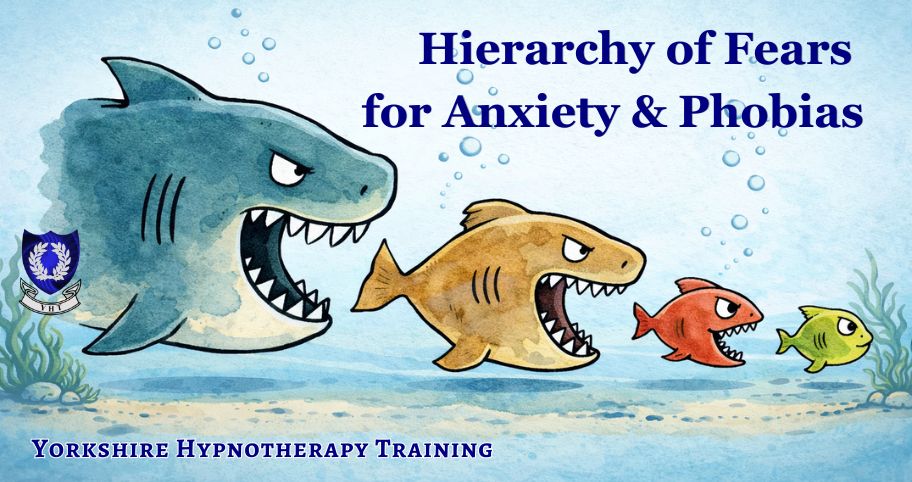
A hierarchy of fears is a widely used technique in hypnotherapy and other therapies to help clients gradually reduce anxiety and phobic responses. It works on the principle that it is difficult to feel relaxed and anxious at the same time, allowing clients to build confidence step by step as they face increasingly challenging situations.
Although most hypnotherapists will use this technique in trance, it can also be adapted for use without hypnosis if required.
Creating a Hierarchy of Fears
This step-by-step, desensitisation approach is often used when working with phobias, anxiety and other fear-based responses. Firstly, out of trance, ask the client to make a list of what they fear, starting with the least scary aspect of it and ending with the scariest. Assign a SUDS score to each level. As an example, for someone scared of sharks, that might be:
A cartoon shark like the one accompanying this article – 1
A realistic drawing of a shark – 3
Touching a cuddly toy shark – 5
Looking at a photo of a real shark – 5
Watching a video of a real shark – 6
Being around a real shark, for example, in a sea life centre – 10
Swimming with sharks might be in there, too, but most people can avoid that much close contact without any trouble! If your client is going to Australia to surf, though, you might want to include it.
I’d suggest restricting this list to no more than a dozen or so items. It’s useful to use a pro forma for this and you can download one free of charge at the bottom of this article.
How to Use a Hierarchy of Fears in Hypnotherapy
Before you start this step, make sure your client knows at least one relaxation technique and set up a positive anchor or stacked positive anchors.
Guide the client into deep relaxation or trance, ideally using a safe place or similar calming imagery.
Ask the client to imagine being around the lowest item in the hierarchical list and let you know when their fear reaches the scored level. In our example, ‘imagine looking at a cartoon shark’ and let that feeling reach 1/10.
Talk them through using the relaxation technique and setting off the positive anchor, make suggestions about reducing fear and anxiety responses, then ask them to score the fear again by saying a number aloud. It should have gone down.
Sign up for YHT's Newsletter: tips, research, articles and training discounts
Keep using the anchor and the relaxation until it goes all the way down to a zero. That may take some time, but don’t move on until the fear is definitely at zero. If you move on too soon, it won’t work properly.
Once it’s at zero for the cartoon, move on to the next step (a realistic drawing of a shark at 3/10 in the example) and repeat the same procedure.
Essentially, you do the same with each item on the list, working gradually from the least to the most challenging situations. It’s very repetitive, and it may take several sessions to work your way through the whole hierarchy. Take your time and do not move on to the next stage until the client is 100% confident at the current one. The gradual exposure is important to helping the client desensitise to the feared situation while remaining relaxed and in control.
Don’t be afraid to add extra help, like a dial for turning down the fear, in addition to the relaxation technique and anchor, if it helps.
Tips for Using a Hierarchy of Fears with Clients
- It can take a long time to get the first couple of items down to zero. Be patient, sooner or later, most clients will get ‘on a roll’, and the scores will reduce more quickly.
- If you hit a problem and they can’t reduce something to zero, one of the following may help.
- Teach a different relaxation exercise or strengthen the anchor.
- Go back to the previous item on the list and build their confidence again.
- Dissociate the client slightly, for example, watching another person (or an image of themselves) looking at a real shark before imagining doing it themselves.
- Teach a different relaxation exercise or strengthen the anchor.
- If none of this helps, consider moving to a different desensitisation technique for that item, such as collapsing anchors.
- After you have about half the items on the list down to zero, ask the client to check their original hierarchy and tell you if any of the higher scores have changed. Often, they have come down spontaneously as you cleared out the items underneath. If it’s a long list, do this more often.
- If you don’t get whatever you are working on down to zero by the end of a session, add some suggestions that it will stay at whatever it is at that point until the next session, and go back and pick up where you left off when you see them again.
- Always finish each session with a good result/at the end of a level, and add self-esteem and confidence-boosting suggestions before reorienting the client.
Free Download
Download a free Hierarchy of Fears pro forma, in Word format so you can add your practice details.

About Debbie Waller
Blog Author Debbie Waller is a hypnotherapist, supervisor, and trainer with more than twenty years of experience. As well as having a busy client practice, she runs Yorkshire Hypnotherapy Training and writes books and articles for therapists who want to deepen their knowledge and develop effective practice.

Disclaimer
The information and ideas shared on this blog are based on the author’s professional experience, research, and training. They are intended for educational purposes and to support reflection and professional development. Therapists should always apply their own professional judgment and consider the needs of individual clients when using any techniques or suggestions discussed here.
While every effort is made to ensure the information is accurate and helpful, no responsibility can be accepted for any loss, damage, or difficulties arising from the use or misuse of material contained in these articles.