Defining hypnosis has always been tricky. We can see the effects of hypnosis, but understanding exactly how hypnosis works is far more challenging. Recently, neuroscience and hypnosis research have begun exploring what happens in the brain during hypnosis, although there is still debate about how hypnosis should be defined and explained. As Pratt et al, (1988) said:
‘Hypnosis has always been an enigma, and it can be said that the more it is subjected to the light of modern empirical scrutiny, the more it eludes definition.’
In this article:
- Does hypnosis exist?
- What happens in the brain during hypnosis?
- Neuroscience research into hypnosis and brain function
- Changes in perception during hypnosis
- Can neuroscience explain hypnosis?
- Can neuroscience answer the state/non-state question?
- The future of research
In this article, I’m going to see how recent advances in neuroscience might help us to resolve that enigma and shed some light on the nature of hypnosis.
Does Hypnosis Exist?
There have always been disagreements about what hypnosis is and what it can do. Historically, the arguments tended to be around whether hypnosis was primarily a physical state (Mesmer’s Animal Magnetism, Charcot’s emphasis on pathology) or a psychological one (Braid’s neurophysiological theory, Liebeault and Bernheim’s psychotherapy). But there have also been discussions about whether it exists at all. That particular argument works like this.
- The ‘non-state’ (or socio-cognitive) theories say that hypnosis essentially doesn’t exist except as a social construct. In this theory, people taking part in hypnosis are actively involved with what is going on, and their response to suggestions made by the hypnotist are explained by contextual and psychological factors like compliance, conformity, obedience, social roles, expectation, etc. Inductions and other rituals connected with hypnotising people simply enhance those other effects. (Sarbin, 1950; Spanos, 1986; Kirsch, 1985, 1991, 1994)
- The ‘state’ (or intrapersonal) theories work on the basis that hypnosis exists and is an identifiable and specific altered state of consciousness. Responses to suggestions made by a hypnotist are a result of being in this altered state of consciousness which creates change in suggestibility, brain function, or reality distortions. Of course, the other factors mentioned above also play a part (we can’t avoid them) but they do not explain all the results. (Hilgard, 1974, 1986; Woody & Bowers, 1994; Gruzelier, 1998).
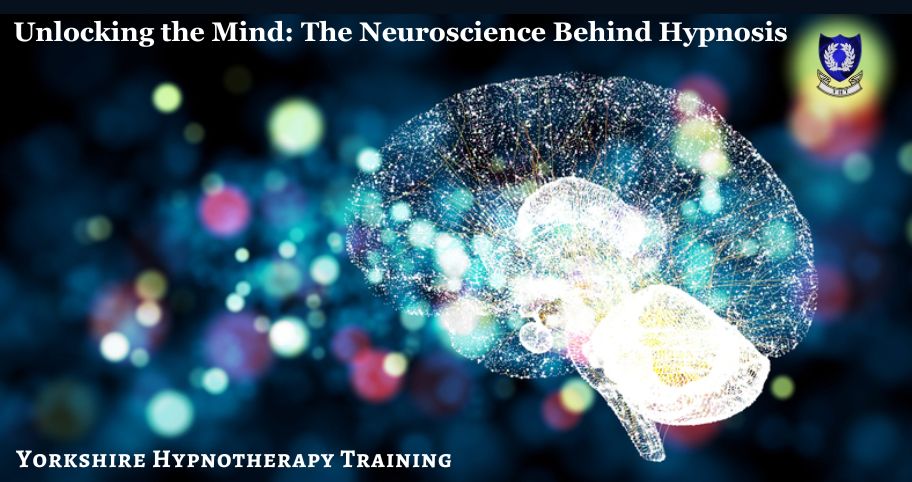
With new technology, such as functional neuroimaging, researchers can see precisely how hypnosis changes the brain’s activity. This means that neuroscience can hopefully give us a greater understanding of hypnosis and how it works to help our clients.
What Happens in the Brain During Hypnosis?
A study carried out at Stanford University (Jiang et al. 2017) used functional imaging to record brain activity in four different conditions, which were applied in different and random order, using subjects who scored both very high and very low for hypnotisability:
- Being asked in hypnosis to imagine a time when they felt happy,
- Being asked in hypnosis to remember or imagine a holiday,
- Being in a resting but un-hypnotised state,
- Being asked to recall a memory in an un-hypnotised state.
This showed that when subjects were hypnotised the following changes happened:
- Focused Attention: Activity was reduced in the Dorsal Anterior Cingulate Cortex, which is a warning system that tells you when something needs your attention. When it slows down, your focus is narrowed, and it helps you to ignore distractions.
- Emotional Control: The connections between the Dorsolateral Prefrontal Cortex and the Insula increase. The DLPFC controls what we think of as the ‘executive functions’ that help with planning and decision-making. The Insula monitors your bodily awareness and emotional responses. When the two work more closely together, you have more control of your physical and emotional reactions.
- Reduced Self-Awareness: Hypnosis reduces the connections between the Dorsolateral Prefrontal Cortex and the Default Mode Network. The DMN includes the Posterior Cingulate Cortex, which is linked to self-awareness, while the DLPFC is linked to executive functions. When the self-awareness and decision-making parts of the brain are less connected, you feel less self-conscious and less aware of normal, everyday thoughts. You are immersed in what is happening ‘in the moment’.
Sign up for YHT's Newsletter: tips, research, articles and training discounts
Neuroscience Research into Hypnosis and Brain Function
Other studies, such as Egner et al. (2005) and Rainville & Price (2003), have supported the idea that hypnosis alters brain regions involved in attention control, sensory experiences and inhibition.
That goes a long way towards explaining the effects we see both on the stage and in the therapy room. If hypnotised individuals
- feel less inhibited by what they think they “should” do,
- think, or feel, interpret sensory experiences differently,
- have greater control over usually automatic responses, and
- focus more strongly on the interaction between themselves and the hypnotist,
they are much more likely to respond to suggestions, whether that means clucking like a chicken or experiencing less anxiety or pain.
Changes in Perception in Hypnosis
You will almost certainly have come across the Stroop Effect, even if you don’t know the name. It’s when people have trouble processing conflicting bits of information.
Try this. Name the colour of this text out loud.
BLUE
Did you find that tricky? The red text creates a conflict between the instruction to say the colour, and the automatic urge to read the word. This happens even if you said ‘red’ and even if you said ‘red’, it probably took you longer than you’d usually need to read such a simple word.
In hypnosis, however, people can bypass this conflict, suggesting a change in automatic thought processes. The processing conflict disappears when hypnotised subjects receive a suggestion to view letters as meaningless symbols (Oakley & Halligan, 2011). Then, subjects can say the colour of
BLUE
as easily as
BLUE.
This works with other automatic attentional processes as well.
Other researchers (Raz and Campbell, 2011) have referred to this as ‘hypnotic dyslexia’ and it’s possible that comparing scans of neurotypical and dyslexic people in and out of hypnosis who are processing this kind of task will help us understand more about that condition.

Can Neuroscience Explain How Hypnosis Works?
I believe it gets us further forward but doesn’t (yet) provide a fully satisfactory definition.
Most studies are more focused on what hypnotherapy does rather than what it is, so there are still questions to ask about its fundamental nature.
Does Neuroscience Support State or Non-State Theories of Hypnosis?
The research strongly suggests that, under hypnosis, predictable brain changes take place which implies a distinct state. But, again, most researchers look at the brain’s reactions to suggestions during hypnosis rather than on the hypnotic state itself. (Halligan & Oakley, 2014)
To clarify whether these changes are due to hypnosis or simply the power of suggestion, we need more studies comparing the brain’s response to suggestions both in and out of a hypnotic state.
The Future of Neuroscience and Hypnosis Research
Kihlstrom (2013) says that ‘Future developments in this area … will require more than machine time, computational power, and a tame hypnotist.’
I’ve already mentioned the possibility of gaining more understanding of dyslexia by using hypnotic suggestions, and other conditions might benefit in the same way. For example, Kihlstrom (ibid.) also suggests that, by comparing scans of brains before, during and after a hypnotically induced amnesia experience, we may learn a lot about how memory works.
While some elements of hypnosis remain difficult to pin down, exploring it through neuroscience is offering fresh insights. And it works both ways. In exploring hypnosis, we might also come to a better understanding of brain functions like memory, attention, and even conditions like dyslexia.
So, as we learn about hypnosis from neuroscience we can also reach a better understanding of neuroscience from hypnosis.
References:
Cerebral Cortex, Volume 27, Issue 8, August 2017, Pages 4083–4093, https://doi.org/10.1093/cercor/bhw220 [Accessed November 2024]
Egner, Tobias, Jamieson, Graham, Gruzelier, John, Hypnosis decouples cognitive control from conflict monitoring processes of the frontal lobe, NeuroImage, Volume 27, Issue 4, 2005, Pages 969-978, ISSN 1053-8119, https://doi.org/10.1016/j.neuroimage.2005.05.002. [Accessed November 2024]
Halligan, P. W., & Oakley, D. A. (2014). Hypnosis and beyond: Exploring the broader domain of suggestion. Psychology of Consciousness: Theory, Research, and Practice, 1(2), 105–122. https://doi.org/10.1037/cns0000019 [Accessed November 2024]
Hypnosisandsuggestion.org. (2012). Theories of Hypnosis | Hypnosis and Suggestion. [online] Available at: https://hypnosisandsuggestion.org/theories-of-hypnosis.html. [Accessed November 2024]
Kihlstrom JF. Neuro-hypnotism: prospects for hypnosis and neuroscience. Cortex. 2013 Feb;49(2):365-74. doi: 10.1016/j.cortex.2012.05.016. Epub 2012 Jun 5. PMID: 22748566; PMCID: PMC3528837. [Accessed November 2024]
Pratt et al, (1988) A clinical hypnosis primer, New York: John Wiley and Sons.
Rainville, P., & Price, D. D. (2003). Hypnosis Phenomenology and the Neurobiology of Consciousness. International Journal of Clinical and Experimental Hypnosis, 51(2), 105–129. https://doi.org/10.1076/iceh.51.2.105.14613 [Accessed November 2024]
Oakley, D. A., & Halligan, P.W., Using hypnosis to gain insights into healthy and pathological cognitive functioning, Consciousness and Cognition, Volume 20, Issue 2, 2011, Pages 328-331, ISSN 1053-8100, https://doi.org/10.1016/j.concog.2010.01.013. [Accessed November 2024]
Raz, A., & Campbell, N. K. J. (2011). Can suggestion obviate reading? Supplementing primary stroop evidence with exploratory negative priming analyses. Consciousness and Cognition: An International Journal, 20(2), 312–320. https://doi.org/10.1016/j.concog.2009.09.013 [Accessed November 2024]
Main photo – metamorworks on iStockPhoto

About Debbie Waller
Blog Author Debbie Waller is a hypnotherapist, supervisor, and trainer with more than twenty years of experience. As well as having a busy client practice, she runs Yorkshire Hypnotherapy Training and writes books and articles for therapists who want to deepen their knowledge and develop effective practice.

Disclaimer
The information and ideas shared on this blog are based on the author’s professional experience, research, and training. They are intended for educational purposes and to support reflection and professional development. Therapists should always apply their own professional judgment and consider the needs of individual clients when using any techniques or suggestions discussed here.
While every effort is made to ensure the information is accurate and helpful, no responsibility can be accepted for any loss, damage, or difficulties arising from the use or misuse of material contained in these articles.