Hypnotherapy is a powerful tool in its own right. But some therapists find that combining hypnotherapy with other therapies allows them to tailor their work more closely to the needs of individual clients. Whether it’s integrating trauma techniques, energy work or other therapeutic approaches, many practitioners develop their own unique blend of skills over time. Here, three therapists talk about the additional approaches they use and how they fit alongside hypnosis in practice.
The Integrative Therapists
Angela Rossiter
(Angela Rossiter
Therapeutics)

Nick Davies
(Warwickshire School
of Hypnotherapy)

Mariea Sweeting
(Soul Minds
Hypnotherapy)
What therapy do you combine with hypnotherapy?
Angela – Psycho-sensory Techniques and Principles, often known as Psy TaP. It’s a holistic therapy blending lots of established techniques, many of which have strong neuroscience-based processes.
Nick – My own development, BLAST Technique™. Basically, BLAST™ treats PTSD and trauma by processing the way it is stored physically in the brain. The process is permanent: I offer a guarantee that if they get the trauma back, I will treat it for free. I’ve not had one person take me up on this in over 10 years!
Mariea – I combine Hypnotherapy with Reiki. Hypno-Rei is a way of helping clients relax deeper into Reiki. It enables them to go deeper, and they benefit more from the session. I have worked on cancer patients and those with emotional issues, such as depression and addictions.
Which therapy did you train in first?
Angela – Hypnotherapy
Nick – Hypnotherapy
Mariea – Reiki to Master Level
Sign up for YHT's Newsletter: tips, research, articles and training discounts
Why did you decide to combine hypnotherapy with another approach?
Angela – At a CPD course I saw a demonstration of Psy TaP. I was amazed at the speed of the change in someone who’d had a severe phobia for most of her adult life. The change took place within 5 minutes. It was an ‘eyes open’ experience, with a group of about 10 people viewing the process and the tutor talking us through it at each stage. At the time, I didn’t understand it at all, but I knew that I had to find out more.
Nick – I felt that Hypnotherapy was ineffective in treating trauma, and mostly unconsciously encouraged repression of the event. I developed BLAST™ after seeing how effective EMDR was with trauma. I thought EMDR was still slow, so I decided to research until I found a faster set of tools.
Mariea – I had hypnotherapy for my own issues years ago, which helped. I was a healer before even training in Reiki, and I could see the benefits of training.
How does it work when you use them together?
Angela – Clients like the speed of the change. They’re often surprised to find that something that has affected them for so long can be removed from their life in such a short space of time. Often, you can see the surprise as they look around for the ‘thing’ that they’ve been struggling with for years.
Nick – I make a series of bilateral movements with a pen. The client follows this with their eyes, keeping their head still. The process utilises ‘eyes open’ trance to embed suggestions, leaving the client trauma-free, usually after a few minutes. Once the trauma is processed, they are already in a very relaxed state and open to suggestion. I’ll normally use a rapid hypnotic induction and create a wonderful future for them, asking them how different things will be now the trauma has gone.
Mariea – I have used this since I qualified, as I was already a Reiki Master. I get clients on a therapy couch and use Hypnotherapy to relax them to theta level. I make sure I tell them that I will count them out when we are finished. Then use Reiki healing as usual, and count them out to a normal state of awareness.
What’s the advantage of integrating therapies?
Angela – Speed is the key thing. Significant life changes can take place in less than 5 minutes. A hypnotherapy session straight after Psy Tap allows time for the client to come to terms with the massive changes that have happened for them. And it allows me to future pace and confirm the benefits of the session that they will carry with them for the rest of their life.
Nick – Hypnotherapy alone in my experience is a very ineffective tool for processing this kind of trauma.
Mariea – The advantages are that clients who are nervous about either, get a ‘taster’ of both. They get a deeper Reiki Session, which enables healing. I can talk to them as I would during a hypnotherapy session. Taking them to parts of the body (e.g. where the pain is). They can allow the ‘healing white light’ to wash away the pain. I find that nervous clients find this more ‘acceptable’.
How do the clients react to combining therapies?
Angela – Clients are astounded, sometimes there are tears of relief whilst others look bewildered. In training, we were advised to ask clients to write down how their difficulty affected their lives. What did it stop them from doing? What would they be able to do when it was gone? I ask all clients to do this and afterwards show them their own handwritten words. Most of them look at the paper as if they knew nothing about it – or that it wasn’t even theirs. Some say they don’t remember it being that bad. They’re surprised at what they have written down. Others say that it must have been written on a particularly bad day for them!
Nick – The clients mostly laugh afterwards. That sounds unusual, but a sign of relief, normally after living with it for a number of years. They all report that they feel great afterwards.
Mariea – My clients love it and say they have never had healing like it.

Have you had any issues or ‘interesting experiences’ combining them? (Bearing in mind client confidentiality)
Angela – I had a client referred to me with severe anger management problems. I asked him to write down how it affected him. How his anger affected his life and those around him. And how it would feel to be without it. I could see that he was looking confused as I asked him to follow me through the Psy TaP process. At the end of the session and after a huge release, I showed him his own words. For the next 30 minutes, he cried, and cried, and cried. I then commenced a hypnotherapy session so that he could go home a little more relaxed and less red-eyed. I understand that in just one session, I had changed that man’s life.
A further session had been booked for the following week. I advised him that this was no longer necessary as the changes were permanent. He said that he wanted that session as he thought he might need it. I had no doubts in my mind, but agreed that he could have one last hypnotherapy session. The following week, he confirmed that he didn’t need it. Instead, he spent his session time telling me about his new life and how everybody had immediately noticed changes in him. Family members, work colleagues and even people at his local gym.
Nick – Yes. In the last few weeks, I’ve used it to remove traumatic experiences that have held people back from success. One person called to say they’d just received £25,000 that week. Another became the public ‘face’ of the international blue-chip company they worked for. They had previously been having promotion difficulties!
Mariea – I have had a few incidents, as I used to volunteer at a charity when I first qualified. I was treating carers with emotional and physical issues, at times they had cancer. One lady asked me to go to see her at home: her cancer had spread and she wasn’t able to get to the centre. I went, as I knew her time was nearly up.
We talked through the Hypno-Rei, and I could see her body relaxing totally. I treated her for about an hour. When I brought her back, she told me that she had feelings in areas that she hadn’t felt for 10 years (sexual), and felt a popping in that area, followed by a warm glow. She also told me that she could see her cancer and that it was like a laser attacking it. She knew she was going to pass, and it helped her come to terms with it. It made a big impression on me.
Have you any advice on combining hypnotherapy with other therapies for our readers?
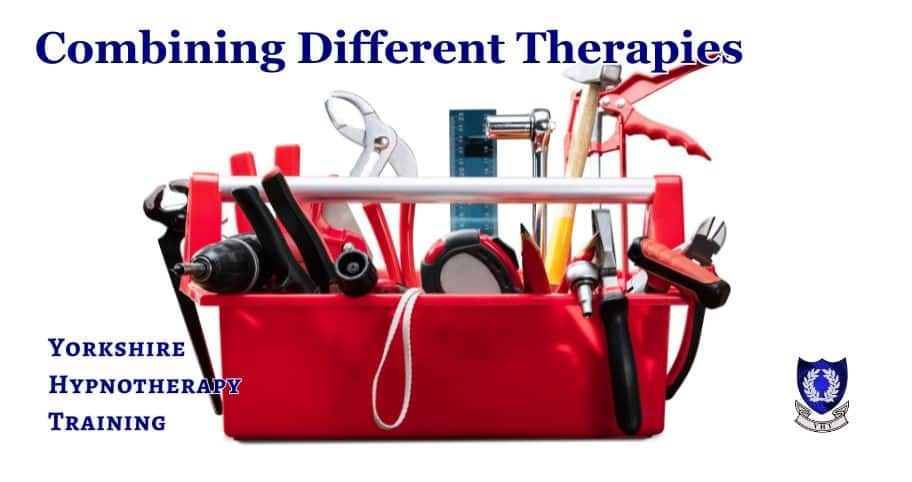
Angela – For those registered and insured, CPD is a requirement. I think it’s imperative that we continue to grow and develop,who along with learning new techniques. There are so many courses available, it can be time-consuming identifying which is the right one for you. Or what might be financially viable at the current time. But adding new tools to your toolbox allows you to help more clients in different ways, along with networking and meeting new therapists and potential friends.
Nick – If you want to learn this technique, you can find out more here.
Mariea – I think it is important to discuss with clients the benefits of combining both and the fact that, for me, I will be having some physical contact or my be using my hands to hover over them, just in case they inadvertently become more awake. I tell them they can wake up at any time. I think proper training is most important in both disciplines. You have to have the understanding and knowledge to be confident to combine them both.

About Debbie Waller
Blog Author Debbie Waller is a hypnotherapist, supervisor, and trainer with more than twenty years of experience. As well as having a busy client practice, she runs Yorkshire Hypnotherapy Training and writes books and articles for therapists who want to deepen their knowledge and develop effective practice.

Disclaimer
The information and ideas shared on this blog are based on the author’s professional experience, research, and training. They are intended for educational purposes and to support reflection and professional development. Therapists should always apply their own professional judgment and consider the needs of individual clients when using any techniques or suggestions discussed here.
While every effort is made to ensure the information is accurate and helpful, no responsibility can be accepted for any loss, damage, or difficulties arising from the use or misuse of material contained in these articles.