Any business with five or more employees must, by law, have a written risk assessment. Smaller concerns, which includes most therapy businesses, don’t have to write down a Health and Safety policy but they should still have one. Despite the fact that it’s not a legal requirement to have this written down, it can be a good idea as part of your ethical or ‘best practice’ approach to running your business.
What is a Risk Assessment?
A risk assessment is just what it says. It’s a check for what might put you – or your clients – at risk of harm, combined with a plan to remove that risk, or at least reduce it as much as possible.
A risk assessment looks at five main areas –
- Identifying potential hazards
- Identifying who might be at risk of harm
- Evaluating the level of risk and creating a plan to reduce or remove it
- Writing all this down, and putting your plan in place
- Reviewing all this regularly
What to Put in a Risk Assessment
What hazards exist in your workplace will vary, depending on where you work and the type of client you work with. Here are a few questions to help you identify some of them, but you can probably think of others.
Identifying potential risks for your client
- Is the client contraindicated for your therapy?
- Are they classed as ‘vulnerable’ and if so, what steps do you need to take to safeguard them?
- Do you need to alter your usual way of working for this client? (for example, does a client on the autistic spectrum find the lights too bright?)
- Do they have psychological or physical health problems that might impact on the therapy in some way?
- What would you do if the client identified a ‘duty of care’ issue such as child endangerment, self-harm or suicidal thoughts?
- If you use products such as aromatherapy oils, do you check for allergies?
- You may well ask many of these questions in your intake, without necessarily using the term ‘risk assessment’ to describe it, but thinking about it in these terms can be helpful to reduce the risk.
Identifying potential risks for you
If you work at home:
- Do you publish your full address online? It might be better to put a postcode, or even the first part of your postcode. This allows clients to know if they can get to you, without the possibility of them turning up unexpectedly on your doorstep.
- Do you have photos of family around in your therapy room or valuables on show? Consider any risks attached to self-disclosure or theft. It might be best to remove them while clients are with you.
Working from client’s homes:
- Does someone know where you are at all times? This has to be balanced with confidentiality of course, but you can leave details like addresses and appointment times in a sealed envelope at home, to be opened only in emergencies.
Wherever you work:
- What would you do if a client’s behaviour made you feel unsafe?
- If there is only one exit, who sits nearest to it – you or your client?
- Do you have an emergency contact if the client is taken ill?
- Are you at risk of allegations about unethical behaviour?
- Do you screen clients before a first meeting, or can anyone use an automated booking system without contacting you?
- Do you have adequate supervision and self-care arrangements to help you deal with upsetting or distressing sessions?
- Do you make it clear how (and how often) you can be contacted between sessions?
Identifying practical and environmental risks:
- Do you have adequate and appropriate insurance in place?
- Is all flooring free from tears, holes and trip/slip hazards?
- Is all electrical equipment PAT tested regularly to ensure it’s safe?
- Could some clients have difficulties in accessing your therapy room or the toilets (e.g. stairs)?
How to Create a Risk Assessment
Build a chart:
- Column one: the hazards you think might exist in your practice (one risk per line)
- Column two: who is at risk of harm in each case
- Column three: the nature of the risk
- Column four: how high the risk is and why
- Column five: what can you do to remove or reduce the risk of that harm?
- Column six: the date you have taken this action
Here’s an example of how entries might look:
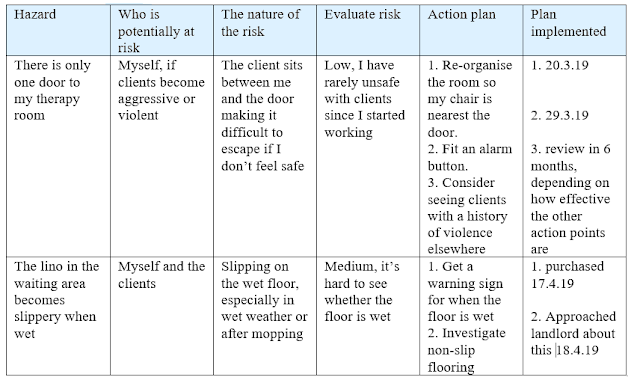
An excel spreadsheet is fine for this, but you can also download a free risk assessment form from the bottom of this article.
Now You Have a Risk Assessment …
All you have to do is put your action points in place and review it from time to time.
This last is essential because things change, for example, a carpet, which is fine now, might develop a tear in a few months and create a new opportunity for someone to get hurt.
Free Risk Assessment Template to Download
References:
Health and Safety Executive (2019). Prepare a health and safety policy – HSE. [online] Hse.gov.uk. Available at: https://www.hse.gov.uk/simple-health-safety/policy/index.htm. [Accessed 15 March 2026]

About Debbie Waller
Blog Author Debbie Waller is a hypnotherapist, supervisor, and trainer with more than twenty years of experience. As well as having a busy client practice, she runs Yorkshire Hypnotherapy Training and writes books and articles for therapists who want to deepen their knowledge and develop effective practice.

Disclaimer
The information and ideas shared on this blog are based on the author’s professional experience, research, and training. They are intended for educational purposes and to support reflection and professional development. Therapists should always apply their own professional judgment and consider the needs of individual clients when using any techniques or suggestions discussed here.
While every effort is made to ensure the information is accurate and helpful, no responsibility can be accepted for any loss, damage, or difficulties arising from the use or misuse of material contained in these articles.