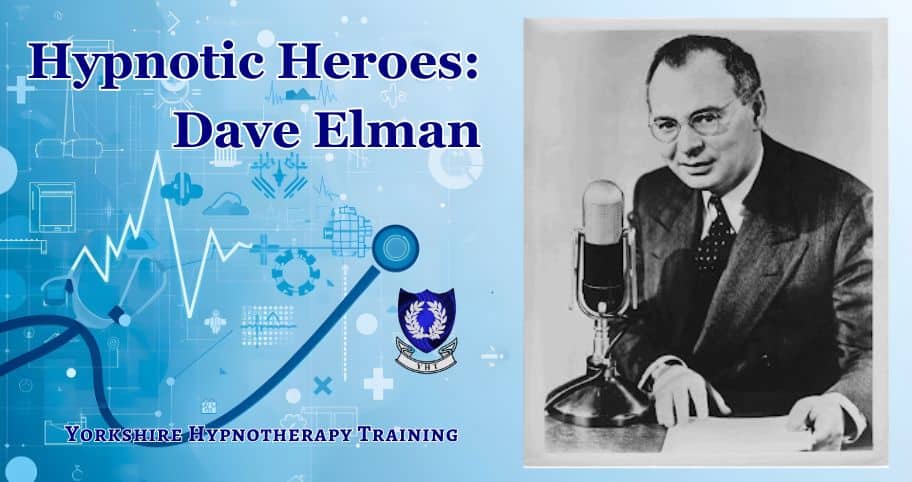
Dave Elman was born David Kopelman, son of Jacob and Lena, on May 6th 1900. He was raised as one of a large family, in Fargo, North Dakota. Jacob ran a business making wigs and theatre equipment. This likely gave David a good knowledge base for his later performance career.
In this article:
- Elman’s early life
- The World’s Youngest and Fastest Hypnotist
- Dave Elman’s radio career
- Medical relaxation
- What is hypnosis?
- The Elman Induction
- How does the Elman Induction work?
- How to use the Elman Induction online
Elman’s Early Life
When David was very young, his father Jacob was diagnosed with terminal cancer. As it progressed it caused him severe pain, which traditional medicine failed to treat. A family friend happened to be trained in stage hypnosis, and effectively relieved Jacob’s pain. David saw how effective it was, and became fascinated with hypnosis as a treatment.
Jacob died when David was eight, leaving Lena with six children and one more on the way. With little governmental social support existing in 1908, David had to start work very early to help support the family. He worked various jobs in his early teens but had the most success in performing as a musician. He specialised in saxophone and violin, but was also a comedian and stage hypnotist in Vaudeville.
The World’s Youngest and Fastest Hypnotist
In 1922, David arrived in New York under the name he became better known by later, Dave Elman. Anglicised stage names were popular so an English-speaking audience can remember them more easily. But he always said he chose a shorter name so bigger letters could be printed on posters and marquees. Stage acts require quick results to keep the audience interested, so Elman developed induction methods which could put a person in trance in mere seconds. He soon became well-known as ‘The World’s Youngest and Fastest Hypnotist’.
Elman later moved into writing and producing music, working with famous blues musician W. C. Handy to write songs such as the famous ‘Atlanta Blues’. Around this time he met his future wife, Pauline Reffe. In 1928, he started working in network radio in New York, where he wrote, directed, produced, and performed in various shows for and with celebrities such as the singer Kate Smith.
Dave Elman’s Radio Career
In 1937, Elman began a new NBC radio show named Hobby Lobby, in which ordinary people would talk about their unusual hobbies. The show was a runaway success, and ran coast to coast for over a decade. It was so famous that First Lady Eleanor Roosevelt stood in as host when Elman was unavailable, twice! During WW2 she and Elman advocated therapeutic hobbies for soldiers, and he raised money for the war effort by auctioning war bonds.
In 1948, Elman organised a charity show, but the top-billing act had to drop out. Unable to find a replacement at such short notice, Elman went on himself and performed his old hypnosis tricks. After the show, a doctor from the audience came backstage. He asked Elman to teach him how to use hypnosis for medical treatment.
Sign up for YHT's Newsletter: tips, research, articles and training discounts
Medical Relaxation
Elman developed a training course in what he called Medical Relaxation. At first, he taught a team of fifteen doctors, but he received many requests from other medical professionals. So, he spent the next thirteen years travelling throughout America, teaching his course to doctors, dentists, and therapists. He also published it as a set of audio recordings to spread it even further, with a set of recordings of actual hypnosis sessions entitled ‘Hypno-Analysis’.
After a long illness in 1963, he decided to write a book. His wife Pauline took dictation for a living, and so was able to type out the book for him. Their son Robert was an editor, and took on that part of the work. Elman released a 336-page self-published book entitled ‘Findings in Hypnosis’. Retitled ‘Hypnotherapy’ in 1978, the book is still in use. Elman died a few years later, on 5th December 1967. He is often credited with teaching more people to use medical hypnosis than anyone else.
What is Hypnosis?
Elman listed three required points for hypnosis.
- First, the subject must be willing;
- Second, the hypnotist and the subject must communicate well;
- Third, the subject must trust the hypnotist.
All successful hypnosis methods take these into account. He also found five common signs of trance. First, warm hands show the client is comfortable and relaxed, and likely to be easy to hypnotise. Next, when entering trance, the eyelids flutter, the eye whites turn pink or reddish, and the eyes water. (Elman suggested this was because the tear ducts relax.) Finally, the eyes roll upward.

The Elman Induction
Altogether, this induction can take less than four minutes. Dave called it the 3-minute routine or ‘3 trips to Bernheim’. This was a reference to Hippolyte Bernheim who ran the Nancy School of Hypnosis around 1880. Today it’s generally known as the Elman Induction.
Elman’s hypnosis method is especially good for medical use for multiple reasons.
- Because it is very quick, you can use it in busy settings such as hospitals.
- The hypnotist can see results immediately, as it includes built-in tests.
- It is effective for over eighty-five per cent of subjects, often including those don’t respond to slower inductions.
- It allows the hypnotist to test repeatedly how successfully the subject is entering trance.
How Does the Elman Induction Work?
- Brief suggestions for comfort and relaxation
- Glued eyelids convincer – suggest that the subject can relax their eyelids so much that no matter how hard they try, their eyes will not open. Then invite them to test that.
- Stop testing and let the relaxation from the eyelids move through the whole body.
- Fractionation deepener – this works on the idea that bringing someone partly out of trance and then back in deepens the trance. Tell the client you are going to count to three,. On three, they will open their eyes briefly, then relax more as they close them again. Repeat this a couple of times till you see the client is struggling to open their eyes, or the eyes are becoming red and teary.
- Arm lift for feedback – tell the client you are going to pick up their arm. When you do, they should keep it completely limp and relaxed, not helping you in any way. Pick up the arm (I favour taking hold of the wrist) and move it slightly. Encourage the client to relax the arm more as you do so. Once the arm feels completely relaxed, tell the client you will gently drop it back into their lap, and they will relax even more. Do this.
- Losing the numbers “amnesia test” – ask the client to count backwards from a hundred, repeating the words “deeper and deeper” between each number. Count the first number or two with them, then leave them to count while you talk over them, giving suggestions that each number will make them relax more. And that the more relaxed they become the easier it is to let the numbers go until they reach their perfect level of relaxation and stop counting.
There are various scripts around, all claiming to be “the original”. I suspect that, Elman would have worked off the cuff and adapted to his client, he used most of them, if not all, at some point.
How to Use the Elman Induction Online
The main issue with completing the original version of the Elman induction online is the floppy arm test for muscle relaxation. But as we can’t see our clients as clearly, there may be other parts, such as the glued eyes, that we want to adapt as well.
You can download my adaptation, for use online or with groups, below.

About Debbie Waller
Blog Author Debbie Waller is a hypnotherapist, supervisor, and trainer with more than twenty years of experience. As well as having a busy client practice, she runs Yorkshire Hypnotherapy Training and writes books and articles for therapists who want to deepen their knowledge and develop effective practice.

Disclaimer
The information and ideas shared on this blog are based on the author’s professional experience, research, and training. They are intended for educational purposes and to support reflection and professional development. Therapists should always apply their own professional judgment and consider the needs of individual clients when using any techniques or suggestions discussed here.
While every effort is made to ensure the information is accurate and helpful, no responsibility can be accepted for any loss, damage, or difficulties arising from the use or misuse of material contained in these articles.
Acknowledgements:
Co-author of this article: Rachel Waller.
Thanks to Cheryl Elman for her support: the image of Dave Elman on the header is a radio publicity shot taken circa 1937-41 and is included with her permission.
Thanks to Jason Linett, I developed some of my ideas for adapting the induction for online working from his podcast.